

Wrike makes work flow in your organization by helping team members collaborate with each other. But what happens when your teammate is an AI agent? It may sound like the plot of a science fiction movie, but it’s closer to reality than ever. And Wrike isn’t alone in thinking so.
We work regularly with key analyst firms like Forrester, IDC, 451 Research, Constellation Research, and more, and they are all discussing how AI automation of collaborative work is not just the future — it is table stakes.
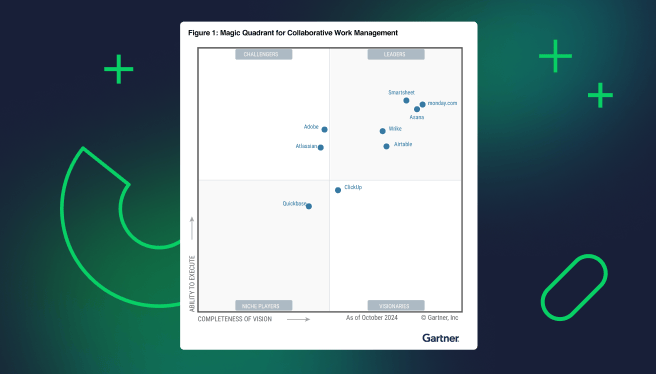
We believe that’s certainly one of the main trends of note in the latest Gartner research, where Wrike was named, for the 3rd year in a row, a Leader in the Gartner® Magic Quadrant™ for Collaborative Work Management, 2025.

Wrike recognition in CWM
Wrike has a nearly 20-year history in collaborative work management (CWM). The category — while not always called “CWM,” but sometimes variations like project management, portfolio management, or team collaboration — is growing and being actively followed by several key analyst firms that seek to help buyers make the right decisions on their technology purchases.
IDC, Forrester Research, and QKS Group have all published CWM-specific evaluation reports, each with their own take on what’s most important in the market. AI is now making new ways of working possible across many of the features and use cases that we believe are measured by Gartner and others, transforming areas like dashboarding, request forms, intelligent resource management, and more.
Both in the Gartner report and several other evaluations, we believe our placement emphasizes that Wrike not only is able to “check the box” for AI-enabled capabilities, but also infuse AI into multiple workflows and processes to make them smarter, enabling us to meet a broad set of needs.

How AI is reshaping CWM
Look deeper into this report and many others, and you’ll see how AI (and particularly agentic AI) is quickly changing the criteria and capabilities that are most important to buyers.
It’s not just Wrike or CWM that is reshaped by AI; every software company everywhere is now an AI company. If they aren’t, they aren’t going to be around very long to help keep your work flowing.
That’s why Wrike has accelerated our investment in this future, announcing both prebuilt agents and a no-code agent builder to put the power of AI directly into the hands of business users.
Uniquely, we’ve also explored the ways AI can take visual planning, mapping, and other kinds of visual or unstructured data and put it to work within workflows. The addition of Wrike Whiteboard (powered by Klaxoon) and Datahub to Wrike’s product portfolio helps further accelerate this type of in-context collaboration, ensuring Wrike never becomes a silo.

New tech, new categories
Both within CWM and beyond, the same shifts are happening, further blurring lines with adjacent markets — not only in visual collaboration, but also strategic portfolio management (SPM), project portfolio management (PPM), and adaptive project management and reporting (APMR). Specific segments/use cases within CWM (like marketing work management and professional services automation) are also being recognized as distinct categories.

How can agents enable a deeper, more vertical, and use-case-specific level of expertise and best practice? How will agents work across these categories to automate work? In some cases, AI has shifted what’s possible within a category so significantly that it changes the name of the category itself — case in point, just this week, IDC published a MarketScape not just on PSA, but specifically “Worldwide AI-Enabled PSA Applications,” where Wrike was named a Major Player. Literally dozens of entirely new categories are emerging as well, such as intelligent work assistants.

Automate the future with Wrike
Regardless of which of these markets sounds like a fit for your work management needs, Wrike will be here at the forefront as repeatable work becomes more automated than ever. Our platform can take care of your team’s specific needs, whether it’s people collaborating with each other, or AI agents getting to work on the tedious stuff so workers at every level can focus on strategic work that requires focus and time.
We encourage you to both dig into the research from these fantastic firms, and dive into the research Wrike has conducted ourselves on the impact of AI.
Gartner®, Magic Quadrant™ for Collaborative Work Management, Nikos Drakos, Joe Mariano, Lacy Lei, Hironori Hayashi, 28 October 2025.
GARTNER is a registered trademark and service mark of Gartner, Inc. and/or its affiliates in the U.S. and internationally, and MAGIC QUADRANT is a registered trademark of Gartner, Inc. and/or its affiliates and are used herein with permission. All rights reserved. Gartner does not endorse any vendor, product or service depicted in its research publications, and does not advise technology users to select only those vendors with the highest ratings or other designation. Gartner research publications consist of the opinions of Gartner’s research organization and should not be construed as statements of fact. Gartner disclaims all warranties, expressed or implied, with respect to this research, including any warranties of merchantability or fitness for a particular purpose.