

Key takeaways:
- What leads to agentic AI failures? Failures often stem from DIY agents lacking workflow context, resulting in confusion and inefficiencies in live environments.
- Why is workflow context important? Agents need clear workflows to function correctly, as they require knowledge of task dependencies, approvals, and team dynamics to operate effectively.
- What is the role of enterprise infrastructure? Building agents within established platforms like Wrike ensures security, compliance, and operational integrity, safeguarding sensitive data.
- What are the benefits of Wrike’s AI solutions? Wrike’s AI agents enhance productivity by saving organizations up to 520 hours annually per employee.
- How can organizations optimize AI deployment? Successful AI integration involves grounding agents in structured workflows, outsourcing repetitive tasks, and maintaining strong governance and oversight.
A big part of my job is listening to what works and what doesn’t. That usually means customer interviews, sales debriefs, and product analysis. Sometimes, the most revealing information comes when we onboard new customers coming to Wrike after trying — and failing — to build agentic AI solutions themselves.
Lately, their stories follow a familiar arc: A team created a DIY AI agent, demoed it to leadership, achieved enthusiastic buy-in… and then watched it unravel within weeks. One PM told us that she spent more time fixing her agent’s outputs than she’d ever spent doing the work manually. The cleanup is still ongoing — and now she’s looking to Wrike for help.
That pattern is becoming common. Independently built agents look impressive in controlled demos, then break down in live environments where work is messy, collaborative, and full of dependencies. The failure usually isn’t that the model can’t generate an answer. It’s that the agent wasn’t designed for how work actually happens. And that’s because it wasn’t built where work actually happens.
The PM wasn’t wrong to try. Agentic AI, the kind that takes actions autonomously on behalf of your team, is a transformative technology that has the power to fully overhaul modern work. It’s a major part of our work here at Wrike, where we offer prebuilt and custom agents that already save organizations 520 hours a year, per employee.
The difference, though, is that our agents aren’t standalone solutions; they’re grounded in real workflows, shared context, and clear guardrails.
That’s where the real value lies, and I’m going to explain why.
Agents without workflow context create expensive confusion
Let’s start with a distinction that matters more than people realize.
A prompt tells an agent what to do. A workflow tells it why, when, in what order, and who else is affected.
Most agent deployments I’ve seen fail for one major reason: they rely solely on prompts, which means the agent has zero awareness of upstream dependencies, downstream approvals, or the five other people whose work might shift when this task status changes.
For example, a marketing department might build an agent to automate project status updates. Technically, it works perfectly, pulling data, summarizing progress, and posting updates. But it had no knowledge of a weekly review cycle already in place, compiled by a project manager. So it posts updates that contradict this reporting, confusing multiple colleagues, and leading to endless streams of clarification emails and messages.
McKinsey’s latest Global Survey on AI noted that high performers are nearly three times as likely to fundamentally redesign existing workflows to include AI — rather than parachuting agents in to apply patch fixes. That tracks with everything I’m seeing on the ground. Like their human counterparts, agents need to be embedded in the work to do their jobs properly.
Otherwise, they’re running blindfolded.
At Wrike, we’ve spent years building the data layer that captures how work actually moves through organizations. Task dependencies, approval chains, resource allocations, cross-functional handoffs, and more — it’s all documented, stored, and fully connected to our AI agents, assistants, and automations. That’s the difference between a standalone agent and one built within a work management platform.
Prompt + workflow = agentic AI that actually works.

Agents without enterprise infrastructure make you vulnerable
These days, there are plenty of online discussions that center on the same general topic: “Can I build a project management tool with Claude?”
The answer is yes, for a narrow use case, and sometimes that’s exactly the right place to start. The problem comes when a promising prototype gets mistaken for an enterprise-ready system of work.
With Wrike’s platform, you’re backed by enterprise-grade security and compliance, global support in multiple languages, and a proven track record over 20 years serving household names like Siemens, Walmart, NVIDIA, and The Estée Lauder Companies.

Security matters. Now, Wrike is aligned to our internal enterprise standards, and the users can add all their confidential data in Wrike without having to fear security breaches or compliance issues.
Hannes Leitner, Process Owner, Project Execution

Building apps and agents outside an established infrastructure with clear guardrails can make you vulnerable. As Quang Tuan Dang recently wrote in Forbes, “As agents become more deeply integrated into engineering workflows and production infrastructure, organizations will need to rethink how non-human actors are authenticated, authorized, and governed.”
An AI-built app or once-off agent can be an incredibly useful addition. They can handle a specific task, automate a narrow workflow, and serve as a lightweight interface for a single team. But replacing an entire work management platform? For any organization operating at scale, under regulatory scrutiny, with real accountability requirements, that’s a risky endeavor.
According to Gartner analyst Joerg Fritsch, “Organizations must invest in advanced AI governance and security to protect sensitive data and ensure compliance. This need will likely drive growth in AI security, governance, and compliance services markets, as well as technology solutions that enhance transparency and control over AI processes.”
Meeting that bar requires deep operational infrastructure built over years, not hours.
What works: Enterprise-ready AI with connected agents
Let’s look at the solution to these problems. In my experience, that’s connecting your structured, governed work environment to the most capable AI models available — on your terms and inside your security perimeter.
To meet this need, we built a secure way for AI assistants, such as Claude, to access live Wrike data with the right permissions and context. That’s what our Wrike MCP (Model Context Protocol) Server enables. It empowers assistants and agents with deep context, including years of workflow data, ranging from the smallest missed deadline to the most successful product launch. It’ll make the difference between getting a generic “Sure, I can help you with that!” answer and “Do you want to replicate the Q3’24 model?”

The companies I’m seeing get genuine results from agentic AI have three things in common:
- They ground agents in real workflows and shared context, ideally building agents in Wrike or using Wrike MCP Server.
- They outsource repetitive tasks to AI while keeping human oversight for the high-stakes decisions.
- They operate within established guardrails, factoring in security and compliance from the start.
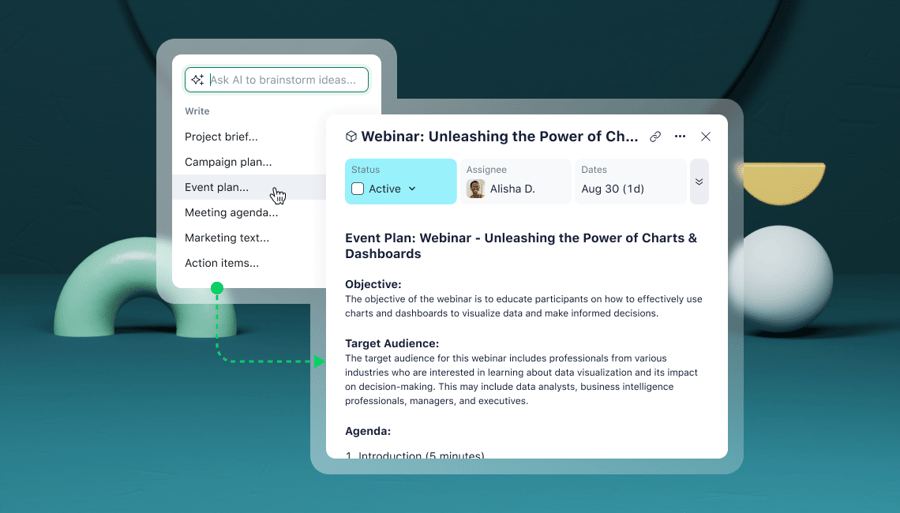
The cleanest and safest way to do this is to use a secure and trusted work management platform with built-in agentic AI. Wrike users can interact with work data through natural language, create custom agents to carry out tasks, and run thousands of automations. Every action — whether initiated by a human or an agent — takes place within Wrike’s secure environment, which offers robust access control, BYOK encryption, a full audit trail, and compliance with industry security frameworks.

Wrike’s AI features have become indispensable in my daily workflow, enabling me to accomplish more in less time and with greater accuracy
De Lisa Patterson, Creative Director

It’s easy to build an agent and make it act. Getting it to act responsibly, appropriately, and intelligently with governance is a tougher ask. But it’s a challenge we’ve been solving for years.
The PM who came to us had the right instinct. She saw what agentic AI could do and wanted to move fast. The problem wasn’t her ambition; it was that she built in a vacuum. Agents don’t fail because the models are weak. They fail because the environment around them is.
That’s the part Wrike knows how to get right.
If you want to see what this looks like in real life, take a trial or schedule a demo. If you’d like to talk more about getting real results from agentic AI, let’s keep the conversation going on LinkedIn.